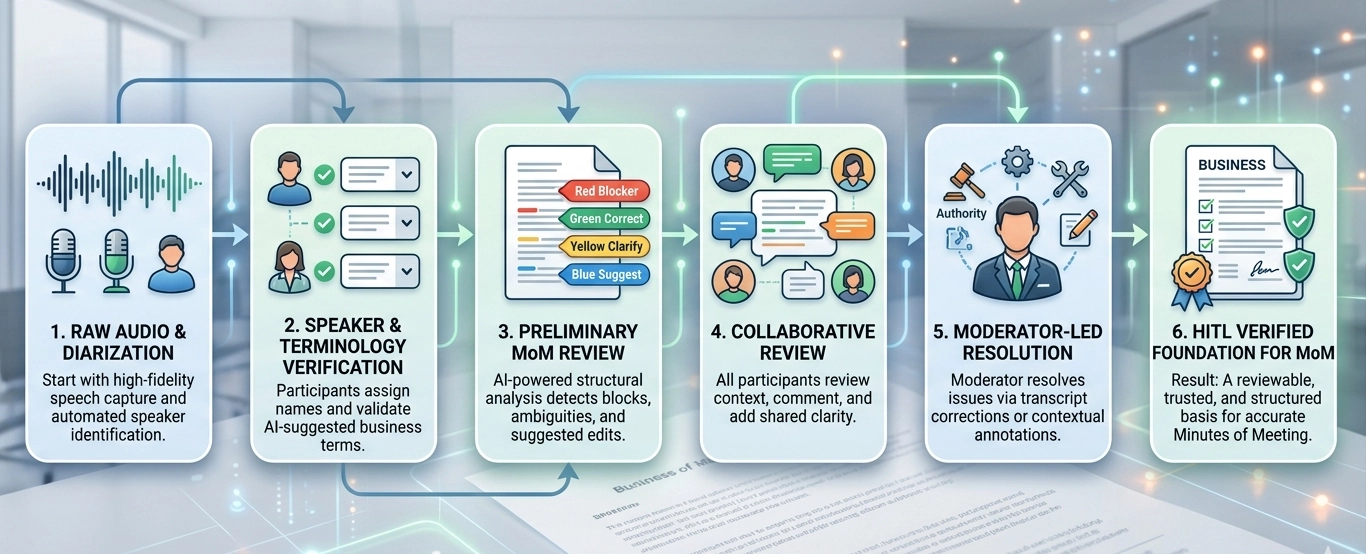
How AI-Transcript Puts
“HITL Verified” into Practice
How raw transcripts become accurate, reviewable Minutes of Meeting
A transcript becomes valuable only when it can be reviewed, trusted, and used to produce reliable Minutes of Meeting.
HITL Verified (Human Intelligence Trust Layer) is the process that ensures this happens.
It combines AI processing with structured human validation—so that what is recorded reflects what was actually said, meant, and agreed.
Step 1: From Audio to Structured Transcript
Each meeting begins with:
1. Audio transcription
2. Speaker separation (diarization)
At this stage, the system produces a raw transcript, organized by speaker segments.
This is the starting point—not the final output.
Step 2: Speaker and Terminology Verification
The HITL process begins with two foundational checks:
Speaker Identification
Participants assign correct names to each speaker in the transcript.
This ensures accountability and clarity across the entire conversation.
Terminology Validation
AI generates a list of suggested term corrections based on the transcript.
Examples include:
- Standardizing terms (e.g. “ai” → “AI”)
- Correcting known names (e.g. “microsoft” → “Microsoft”)
- Identifying possible misinterpretations
Participants review this list and:
- Confirm correct suggestions
- Reject incorrect ones
Once validated, both speaker names and approved terminology updates are applied to the transcript.
This step significantly improves overall accuracy before deeper review begins.
Step 3: Identifying What Prevents a Reliable MoM
The system generates a Preliminary MoM Review.
This is not a summary. It is a structured analysis of what may block the creation of accurate Minutes of Meeting.
AI highlights specific transcript segments and classifies them using four categories:
🔴 Blocker — must be resolved before a reliable MoM can be created
✔️ Correct — accurate as is
❓ Clarify — unclear or ambiguous
💡 Suggest — improvement or additional context recommended
Each item is linked directly to the relevant part of the transcript.
Step 4: Collaborative Review by Participants
All meeting participants can now review the transcript in context.
They can:
- Comment on specific segments
- Respond to AI-identified issues
- Add clarification where needed
- Review and react to other participants’ input
This creates a shared layer of validation, where understanding is aligned across the group—not assumed.
Step 5: Moderator-Led Resolution
Once participants have contributed, the moderator performs a structured review.
Each AI and participant comment is addressed in a controlled way.
There are two distinct types of resolution:
1. Transcript Corrections
If the issue is a clear transcription error, the transcript is corrected directly—without changing meaning.
2. Annotations (Context Without Alteration)
If additional context is required, it is added as an annotation linked to the relevant segment.
Examples include:
- Team commitments and responsibilities
- Due dates and timelines
- Clarifications of intent
- “Not for the record” notes
- Context needed for accurate interpretation
This ensures the original conversation remains intact, while important meaning is not lost.
Step 6: A Reviewable, Reliable Foundation for MoM
At the end of this process, the transcript is:
- Verified by participants
- Structurally reviewed by AI
- Resolved by a moderator
- Enriched with contextual annotations
AI-Transcript creates a reviewable transcript—one that can be trusted as the foundation for generating accurate Minutes of Meeting.
Summary: The AI-Transcript HITL Verified MoM Workflow
By integrating raw AI speed with structured human checks, AI-Transcript turns messy conversation into audit-ready Minutes of Meeting. The entire 6-step validation process ensures that accountability, intent, and clarity are preserved from the moment your audio file is uploaded.
Stage / Phase |
What the System Does | Human Validation Role | Ultimate Output |
|---|---|---|---|
| Phase 1: Extraction (Steps 1-2) | Automatically converts speech to text and splits audio by speaker. | Participants verify speaker identity and approve or reject AI-suggested terms. | A clean, accurately named transcript baseline with zero terminology errors. |
| Phase 2: Analysis (Step 3) | Scans for structural anomalies and marks segments as Blocker, Clarify, or Suggest. | None (Automated diagnostic layer). | A Preliminary MoM Review flagging critical conversational gaps. |
| Phase 3: Alignment (Steps 4-5) | Hosts a collaborative, context-aware space for team communication. | Participants comment and clarify; moderators resolve issues or add timelines. | A fully contextualized transcript enriched with explicit ownership and deadlines. |
| Phase 4: Output (Step 6) | Synthesizes all data points, corrections, and contextual layers. | Final approval by the team/moderator. | A reliable, reviewable foundation for perfect Minutes of Meeting. |